


Most people think motivation is what drives success. But in affiliate marketing, motivation is only the spark; discipline is the engine that keeps your business moving when motivation disappears. If you’ve ever felt excited one day and stuck the next, this post will finally make everything click.
(Quick Summary)
- Motivation gets you started, but discipline keeps you going.
- Motivation is emotional and unpredictable; discipline is structured and reliable.
- Affiliate marketers fail not because they lack motivation, but because they lack systems.
- Discipline is built through small, repeated actions, not big bursts of inspiration.
- If you want long‑term success, build discipline first and let motivation follow.
Once you learn to Build Discipline and apply this, you will then be become more consistent and therefore be more motivated with what you do.
What Motivation Really Is
According to Wikipedia, motivation is “the process that initiates, guides, and maintains goal‑oriented behavior.”
Motivation feels amazing, especially when you first start affiliate marketing. You imagine passive income, freedom, and a new lifestyle.
But motivation is unstable. It rises and falls based on:
- Mood
- Energy
- Environment
- Stress
- Reward cues
Research shows motivation is tied to the brain’s reward system and dopamine spikes, which is why it feels powerful but fades quickly.
Takeaway: Motivation gets you started, but it won’t carry you to the finish line.
What Discipline Really Is
The American Psychological Association defines self‑control (the foundation of discipline) as the ability to regulate emotions, thoughts, and behaviors in pursuit of long‑term goals.
Discipline is not emotional. It’s not exciting. It’s not glamorous.
Discipline is:
- Showing up when you don’t feel like it
- Writing content even when you’re tired
- Sticking to one method instead of chasing shiny objects
- Doing the work consistently
Psychology research shows discipline is linked to the brain’s prefrontal cortex, the part responsible for planning, decision‑making, and self‑regulation.
Takeaway: Discipline is the engine, the system that keeps your business moving when motivation fades.
Motivation vs Discipline: The Real Difference
- Motivation is the spark. Discipline is the system.
- Motivation is emotion‑driven. Discipline is action‑driven.
- Motivation is temporary. Discipline is consistent.
Think of this example:
Motivation says: “I feel like working today.”
Discipline says: “I work whether I feel like it or not.”
This is why successful affiliate marketers aren’t the most motivated, they’re the most disciplined.
How Motivation and Discipline Work Together for Affiliate Marketers.
Motivation gets you started. Discipline keeps you going. Together, they create momentum.
Psychology research shows that action increases motivation, not the other way around. Once you start a task, dopamine rises and motivation follows.
This is the real cycle:
Motivation → Action → Results → More Motivation → More Action
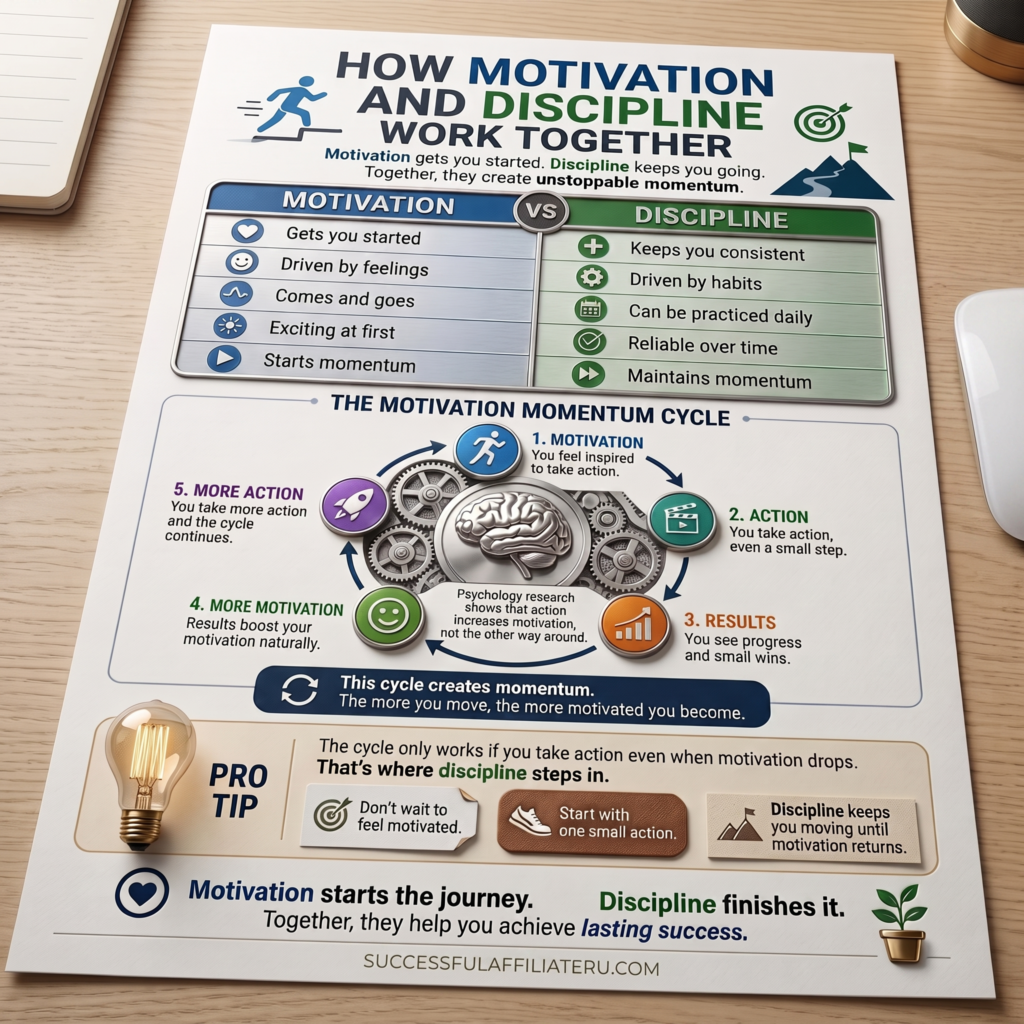
Pro Tip:
The cycle only works if you take action even when motivation drops. That’s where discipline steps in.
Why Discipline Matters More Than Motivation
Motivation disappears the moment:
- Your site gets no traffic
- Your first 10 posts get no clicks
- Your first month earns $0
- You hit a technical issue
- You feel overwhelmed
If you rely on motivation, you’ll quit.
If you rely on discipline, you’ll push through.
Research consistently shows discipline is the stronger predictor of long‑term success than motivation.
Discipline is what turns:
- 1 post into 10
- 10 posts into 50
- 50 posts into a full‑time income
Overcoming Procrastination With Discipline
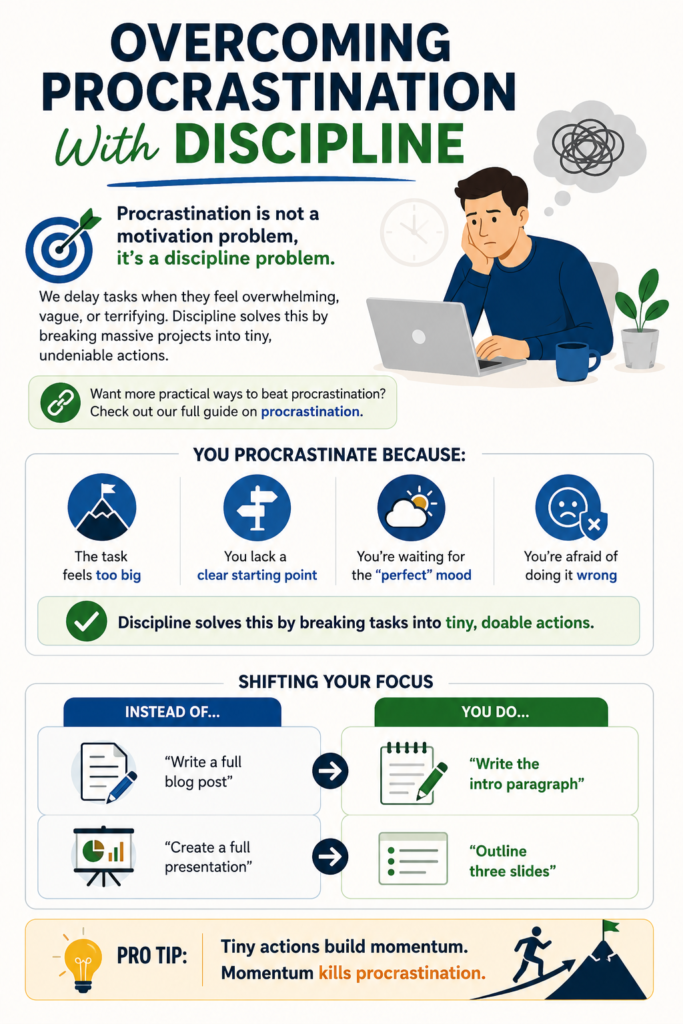
Procrastination is not a motivation problem; it’s a discipline problem.
We delay tasks when they feel overwhelming, vague, or terrifying. Discipline solves this by breaking massive projects into tiny, undeniable actions.
You procrastinate because:
- The task feels too big
- You lack a clear starting point
- You’re waiting for the “perfect” mood
- You’re afraid of doing it wrong
Discipline solves this by breaking tasks into tiny, doable actions.
Shifting Your Focus
Instead of:
- Instead of: “Write a full blog post”
- You do: “Write the intro paragraph”
- Instead of: “Create a full presentation”
- You do: “Outline three slides”
PRO Tip:
Tiny actions build momentum. Momentum kills procrastination.
Here is a summary of what is stated above
How Motivation vs Discipline Applies to Affiliate Marketers
This is where everything becomes real.
When you first discover affiliate marketing, motivation is sky‑high. You imagine passive income, freedom, and working from anywhere.
But motivation can fade fast, especially when results are slow or not happening when you think it should.
The same goes with learning more about Why Building Confidence as an Affiliate Marketer Matters.
The Beginner Trap
Beginners rely on motivation alone. This leads to:
- 12‑hour bursts of work
- burnout
- two weeks of doing nothing
This is why most beginners quit before they see their first commission.
The Struggling‑Marketer Trap
When motivation drops, struggling marketers tend to do this:
- Jump to a new method
- Chase shiny objects
- Look for those the qet-rich quick ways (scams)
- Abandon their niche
- Restart again and again
This destroys momentum.
The Discipline Solution
Discipline is what keeps you:
- Writing content
- Improving SEO
- Building your email list
- Learning one method deeply
- Showing up even when you don’t feel like it
This is the difference between hobbyists and real affiliate marketers.
5 Practical Discipline Frameworks You Can Start Using Today
Building discipline doesn’t require a complete lifestyle overhaul. Often, the biggest improvements come from consistently following a few simple systems.
The frameworks below can help you stay focused, reduce procrastination, and build habits that last.
1. The One-Hour Focus Rule
Set aside one uninterrupted hour each day to work on your most important goal. During that time, eliminate distractions by turning off notifications, avoiding social media, and resisting the urge to multitask.
Even if you only complete one focused hour each day, you’ll make meaningful progress over weeks and months.
2. Break Big Goals Into Tiny Actions
Large projects can feel overwhelming, making it easy to procrastinate. Instead of focusing on the finished result, identify the smallest possible next step.
Try something like this:
- Instead of “Write an entire blog post,” write the introduction.
- Instead of “Exercise for an hour,” commit to a 10-minute walk.
- Instead of “Organise the whole house,” tidy one room.
Small actions reduce resistance, build confidence, and create momentum.
3. Track Your Actions, Not Just Your Results
Many people become discouraged because they focus only on outcomes they can’t fully control, such as income, sales, or website traffic.
Instead, track the actions that lead to those results.
For example, you could keep records on:
- The number of articles published
- Time spent learning a new skill
- Daily workouts completed
When you consistently measure your effort, the results usually follow.
4. Plan Your Week Before It Begins
Rather than deciding what to work on each day, create a simple content or task calendar in advance.
Planning your week ahead can help remove decision fatigue, and allows you to stay productive, even on days when motivation is low. Knowing exactly what comes next makes it much easier to take action.
5. Avoid Shiny Object Syndrome
It’s tempting to jump from one new strategy, tool, or opportunity to another, especially when quick results don’t appear.
Instead, commit to one proven approach for at least 90 days before deciding whether it’s working. This gives you enough time to build the necessary skills, collect meaningful data, and evaluate your progress fairly.
Key Takeaway:
Discipline grows through consistent systems, not occasional bursts of motivation. Focus on small daily actions, trust the process, and give your efforts time to compound.
Final Thoughts: Build Discipline First, Motivation Second
Motivation feels good. Discipline builds success.
If you want to grow as an affiliate marketer, stop waiting to “feel ready.” Start building the habits that move your business forward, even on the days you don’t feel like it.
Your future self will thank you.
Ready to Build Real Discipline? Join Wealthy Affiliate
If you want structure, support, and a proven system that helps you stay consistent, Wealthy Affiliate gives you:
- Step‑by‑step training
- A community that keeps you accountable
- Tools that simplify your workflow, including AI Assistance
- A clear path to long‑term success

FAQ
1. What’s the main difference between motivation and discipline?
Motivation is emotional and temporary, while discipline is a long‑term habit built through consistent action. Motivation gets you started, but discipline keeps you moving when motivation fades.
2. How do I stay disciplined when I don’t feel motivated?
Start small. Commit to one simple task each day. Discipline grows through repetition, not emotion. The more often you show up, the easier it becomes.
3. Can you build discipline even if you’ve always struggled with consistency?
Yes. Discipline is a skill, not a personality trait. Anyone can build it through routines, small habits, and reducing distractions.
4. Which one matters more for online business success: motivation or discipline?
Discipline. Motivation helps you begin, but discipline is what produces long‑term results, traffic, and income.