

Confidence in affiliate marketing isn’t something you wait to feel before you start; it’s something you build through action, one small proof point at a time.
Building confidence as an affiliate marketer is less about eliminating doubt and more about learning to act despite it. Whether you’re just starting out or you’ve been at this for a while and still feel unsure of yourself, the path to genuine confidence looks pretty much the same for everyone.
In this guide, we’ll look at what builds affiliate marketing confidence, the common challenges that can undermine it, and practical ways to become more confident in your decisions, your content, and the recommendations you make.
Key Takeaways
Confidence in affiliate marketing is built through action, experience, and evidence, not by waiting until you feel ready.
- Confidence grows from small wins and real evidence, not from simply telling yourself to be more confident.
- Strong affiliate marketing confidence has three layers: confidence in your content, belief in the products or services you recommend, and trust in the companies behind them.
- Small, realistic goals make progress easier to see and help prevent slow results from damaging your confidence.
- Knowing what you promote builds confidence and credibility, especially when you can speak from genuine experience rather than relying on sales claims.
- Transparency builds trust with your audience, and that trust can reinforce your confidence in your own decisions.
- Self-doubt and imposter syndrome are common challenges, but they don’t mean you’re incapable of succeeding as an affiliate marketer.
Why Building Confidence as an Affiliate Marketer Matters
New affiliate marketers often assume confidence is something they need before they can succeed. In reality, confidence usually develops as you gain experience, make decisions, solve problems, and see evidence that your efforts are moving in the right direction.
When confidence is low, even simple decisions can become difficult. You might spend too long wondering whether your niche is the right one, hesitate to publish content because it doesn’t feel good enough, or constantly question whether you’re recommending the right products. That hesitation can prevent you from getting the experience you need to improve.
Building confidence as an affiliate marketer helps you become more decisive without becoming careless. You learn to research properly, make informed choices, accept that not everything will work, and use the results to improve your next decision.
It also changes how you approach setbacks. A piece of content that gets little traffic isn’t necessarily a failure, and a promotion that doesn’t convert doesn’t automatically mean you’re not capable of affiliate marketing. They’re opportunities to learn what needs adjusting. The goal isn’t to become completely free of doubt. It’s to develop enough confidence in your process that doubt doesn’t stop you from taking the next useful step
The Three Layers of Affiliate Marketing Confidence
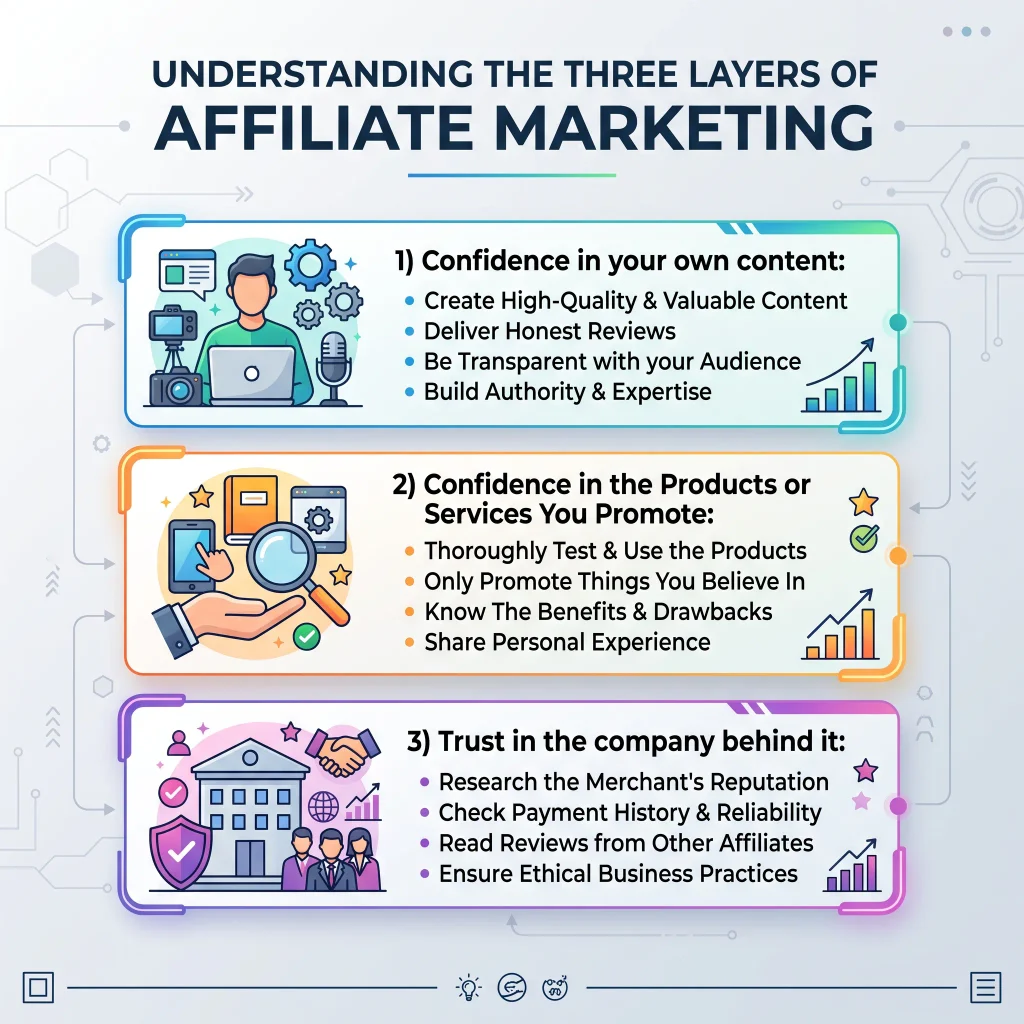
Affiliate marketing confidence isn’t just about believing in yourself. It comes from being comfortable with three different parts of your business: your content, the products or services you promote, and the companies behind those offers.
Understanding these three layers can make it much easier to identify where your uncertainty is actually coming from.
Confidence in your own content:
The first layer is trusting your ability to create useful content.
You don’t have to be the world’s leading expert before you can help someone. If you’ve researched a topic, gained some experience, and can explain what you’ve learned clearly, you can create something valuable for people who are further behind you on the same journey.
Your confidence grows as you publish, receive feedback, improve your writing, and learn what your audience finds useful. Over time, you’re building evidence that you can consistently create content that serves a purpose.
Confidence in the Products or Services You Promote
The second layer comes from knowing and believing in what you’re recommending.
It’s difficult to confidently recommend something you know very little about. Wherever practical, learn how the product or service works, use it yourself, research its strengths and weaknesses, and look beyond the promotional claims made by the company.
You don’t need to pretend that every product is perfect. In fact, being able to explain both the advantages and limitations of an offer can make your recommendations more credible.
When you genuinely understand what you’re promoting, you can focus on helping your audience decide whether it’s right for them rather than simply trying to make a sale.
Trust in the company behind it:
The third layer is confidence in the company or merchant you’re representing.
A product might look appealing, but you also need to consider the business behind it. Look at its reputation, customer support, policies, track record, and how it treats its customers and affiliates.
This matters because your recommendation reflects on you. If you regularly promote companies you don’t trust, you may find yourself second-guessing your own recommendations, and your audience may eventually do the same.
Choosing reputable affiliate programs and businesses you are comfortable standing behind removes some of that uncertainty.
How the Three Layers Work Together
These three layers support one another. You may have complete confidence in your ability to create content but still hesitate because you aren’t convinced about the product you’re promoting. Or you may believe strongly in a product but lack confidence in your own ability to explain its value.
Instead of simply thinking, “I’m not confident enough,” ask yourself which layer is causing the uncertainty.
Once you identify the weak point, you can work on that specific area rather than trying to fix your confidence as a whole.
I particularly like the final part because it gives the reader a diagnostic tool rather than just another motivational message. That will also give us something concrete to refer back to later if we discuss confidence challenges.
Common Confidence Killers for New Affiliates
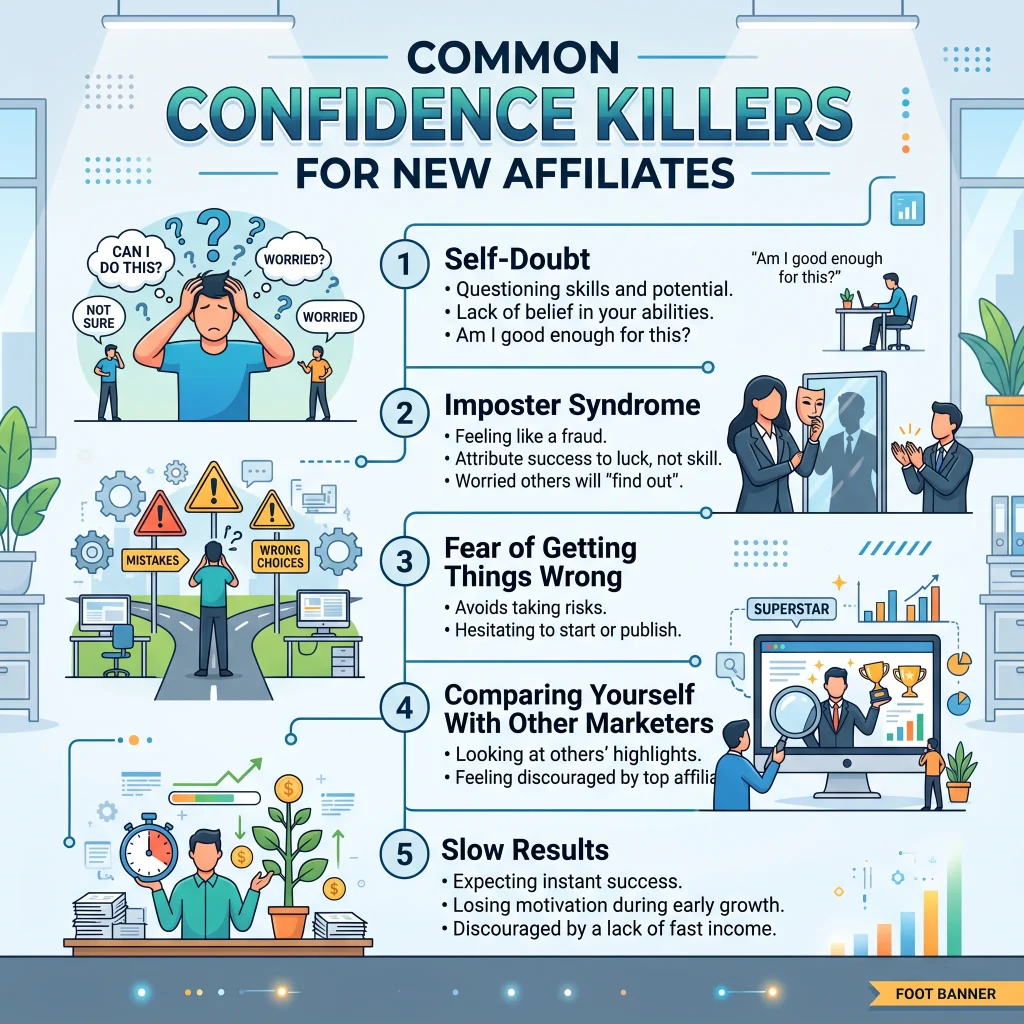
Even when you understand that confidence grows through experience, there are still things that can chip away at it. Some are practical problems, while others come from the way we think about ourselves and our progress.
The important thing is to recognise these confidence killers for what they are. Feeling uncertain doesn’t automatically mean you’re doing something wrong.
Self-Doubt
Self-doubt is probably one of the most common confidence problems for new affiliate marketers.
You might wonder:
- Am I actually good enough to do this?
- What if nobody reads my content?
- What if I choose the wrong products?
- What if I’m wasting my time?
- Who am I to be giving people advice?
These questions can become a problem when they stop you from taking action.
There will always be something you don’t know, especially when you’re starting out. You don’t need to eliminate every doubt before moving forward.
Instead, try to turn vague doubt into a specific question you can answer.
For example, instead of thinking “I don’t know enough about affiliate marketing,” ask yourself, “What do I need to learn to improve this particular article?”
That’s a much easier problem to solve.
Imposter Syndrome
Imposter syndrome is closely related to self-doubt, but there’s an important difference.
You may have learned a great deal, produced useful content, and even started getting results, yet still feel as though you’re not qualified to call yourself an affiliate marketer.
You might look at someone who has been doing this for years and think they know everything while you’re still figuring things out.
But you’re comparing your current stage with someone else’s experience.
You don’t have to be the most experienced person in your niche to be useful. If your content helps someone who is a few steps behind you, you’ve already provided value.
And remember, becoming more experienced doesn’t necessarily make all uncertainty disappear. It simply gives you more evidence to rely on when uncertainty appears.
If imposter syndrome is something you struggle with, it’s worth exploring the subject in more detail rather than letting it quietly influence your decisions.
Fear of Getting Things Wrong
Another confidence killer is the fear of making a mistake.
This can show up in surprisingly simple ways. You might keep editing an article instead of publishing it, spend weeks researching a product before recommending it, or continually change your strategy because you’re worried you’ve chosen the wrong approach.
Research and preparation are valuable, but there comes a point where you have to make a decision and learn from the outcome.
You’re going to make mistakes in affiliate marketing. Everyone does.
The goal isn’t to avoid every mistake. It’s about making sensible decisions, recognising when something isn’t working, and using what you learn to make the next decision better.
That shift in thinking can take a lot of pressure off.
Comparing Yourself With Other Marketers
Comparison can be particularly damaging because affiliate marketing gives you plenty of opportunities to see other people’s apparent success.
You may come across someone talking about their traffic, commissions, email list, website, or years of experience and start wondering why you’re not achieving the same results.
The problem is that you’re usually seeing their outcome, not the years of work, failed experiments, mistakes, and learning that came before it.
Your own progress is a much more useful measurement.
Instead of asking, “Why am I not where they are?” ask: “Am I further along than I was a month ago?”
That question gives you something you can actually measure.
Slow Results
Affiliate marketing rarely provides constant, immediate evidence that you’re making progress.
You can spend hours researching and writing an article, publish it, and then see very little traffic for quite some time.
That can make you question whether your work is worthwhile.
But slow results don’t necessarily mean you’re failing. Some parts of building an affiliate website simply take time, and individual pieces of content won’t all perform equally.
This is why it’s useful to track progress beyond commissions.
Maybe you’re writing better articles, understanding your niche more clearly, improving your SEO, getting more impressions, attracting your first visitors, or becoming more consistent with publishing.
Those are all forms of progress.
Pro Tip:
When you start measuring the smaller signs of improvement, it’s easier to see evidence that you’re moving forward even before the bigger results arrive.
And that’s important because evidence is one of the things that turns uncertainty into confidence.
Practical Ways to Build Confidence as an Affiliate Marketer
Once you understand what’s affecting your confidence, the next step is to work on the things you can actually control. You don’t need to transform your mindset overnight. Small, repeatable actions can give you the experience and evidence you need to become more confident over time.
Set Small, Realistic Goals
One of the easiest ways to damage your confidence is to set a goal that feels so far away that your everyday progress seems insignificant.
Instead of focusing only on large outcomes such as earning your first $1,000 in commissions or getting thousands of visitors, break your work into smaller goals.
For example, you might decide to:
- Publish one useful article this week.
- Improve an older piece of content.
- Research one product thoroughly before recommending it.
- Learn one new SEO concept.
- Spend a set amount of time working on your site each day.
- Review your traffic and content performance once a week.
These goals may seem small, but completing them gives you something important: evidence that you’re taking action and making progress.
Over time, those small wins start to add up.
Learn Your Niche and What You’re Promoting
Knowledge doesn’t automatically create confidence, but a lack of knowledge can certainly undermine it.
The more familiar you become with your niche, your audience, and the products or services you recommend, the easier it becomes to create useful content and explain your recommendations.
Take the time to research what you’re promoting. Where practical, use the product yourself. Read the documentation, understand the features, look at customer feedback, and learn about its limitations as well as its benefits.
You don’t need to know every detail before you can begin.
You simply want to know enough to make responsible recommendations and recognise when you need to learn more.
That also connects back to the three layers of confidence we looked at earlier. If your uncertainty comes from not knowing enough about an offer, improving your knowledge gives you a specific way to address the problem.
Focus on Providing Value, Not Trying to Persuade Everyone
It’s easy to lose confidence when you approach every article thinking, “I need to convince this person to buy something.”
That puts unnecessary pressure on you.
A better approach is to ask:
“How can I make this decision easier for the person reading my content?”
Maybe you can explain a confusing concept, compare two options, point out an important limitation, or help someone avoid a common mistake.
When your primary goal is helping the reader, selling becomes secondary.
You can also be honest when something isn’t suitable for everyone. Saying, “This may not be the right option if you need X,” can be more useful than pretending every product is perfect.
That kind of honesty can strengthen both your credibility and your own confidence in the recommendations you’re making.
Publish, Learn, and Improve
Perfectionism can disguise itself as preparation.
You keep researching, editing, checking, and changing things because you’re worried your content isn’t good enough yet.
At some point, however, you need to publish.
That doesn’t mean publishing careless or inaccurate content. It means accepting that your first version doesn’t have to be your final version.
Once an article is live, you have something you can learn from. You can see how it performs, identify areas that need improvement, update information, and make the next article better.
Action creates experience, and experience creates evidence.
That’s one of the most practical ways to build confidence.
Keep Track of Your Progress
When you’re working on a website for months or years, it’s surprisingly easy to forget how much you’ve learned.
You may still feel like you’re struggling, even though you’re now doing things that would have seemed difficult when you started.
Keep a simple record of your progress.
You could note:
- Articles you’ve published.
- Older content you’ve improved.
- New skills you’ve learned.
- Traffic or impressions you’ve gained.
- Affiliate clicks or commissions.
- Problems you’ve solved.
- Decisions you’ve become more comfortable making.
The numbers aren’t the only thing that matters.
Being able to look back and see that you understand your niche better, write more confidently, or solve problems more quickly is valuable evidence of growth.
Look Back Before You Look Ahead
Here’s a simple exercise that can be surprisingly effective.
Every few weeks, compare where you are now with where you were 30 days ago.
Ask yourself:
What can I do today that I couldn’t do a month ago?
Maybe your answer is researching keywords, writing better reviews, understanding analytics, creating images, improving internal links, or simply sitting down and getting the work done without second-guessing every decision.
Those improvements are easy to overlook when you’re constantly focused on the next goal.
Looking backward for a moment allows you to recognise progress that would otherwise disappear into the background.
And that matters because confidence isn’t built only by achieving big goals. It’s also built by recognising the smaller evidence that you’re becoming more capable.
Learn From Mistakes Instead of Using Them as Evidence Against Yourself
A mistake can either become a lesson or become another reason to doubt yourself.
Suppose an article receives very little traffic. You could decide, “I’m no good at this.”
Or you could ask:
- Was the topic actually useful to my audience?
- Did I understand the search intent?
- Could the article be improved?
- Did I give it enough time?
- What would I do differently next time?
The second approach doesn’t guarantee success, but it gives you something useful to work with.
Understand This:
Confidence doesn’t come from never getting things wrong. It comes from learning that you can deal with things when they do go wrong.
Building Trust With Your Audience
Confidence isn’t only something you feel internally. It also affects how your audience responds to you.
When you know that you’re being honest about what you recommend, it becomes easier to communicate with confidence because you aren’t trying to hide anything or make an offer sound better than it really is.
Be Transparent About Affiliate Relationships
If you’re using affiliate links, make that clear to your readers. An affiliate disclosure shouldn’t feel like something you’re trying to hide in the small print; it should be part of being open about how your website operates.
Transparency helps remove the uncomfortable feeling that you’re trying to persuade someone without telling them that you may earn a commission from their purchase.
Recommend Products You Can Stand Behind
Your confidence is much stronger when you genuinely believe a product or service can help the people you’re recommending it to.
That doesn’t mean you have to claim that every product is perfect. In fact, acknowledging limitations, potential drawbacks, or situations where something may not be suitable can make your recommendation more trustworthy.
Your goal isn’t to convince every visitor to buy. It’s to give them enough useful information to decide whether the offer is appropriate for them.
Let Your Experience Strengthen Your Recommendations
Whenever practical, use the products or services you promote yourself.
Firsthand experience gives you something more valuable than another sales claim: your own understanding of how the product works, what you like about it, and where it may fall short.
If you haven’t personally used something, you can still create useful content by researching it carefully and being clear about what you know and what you haven’t personally experienced.
Trust Works Both Ways
When your audience trusts that you’re trying to help rather than simply make a commission, your content becomes easier to create with confidence.
You don’t have to constantly wonder whether you’re being too promotional because your approach is based on providing useful information and allowing the reader to make their own decision.
That trust can also reinforce your own confidence. When you know that your recommendations are based on research, honesty, and genuine value, you can stand behind your content without feeling that you’re misleading anyone.
Over time, this creates a positive cycle: better recommendations build trust, trust strengthens your confidence, and greater confidence helps you create better content.
When you trust the way you work, it’s easier to trust the decisions you’re making.
Go Deeper Into Specific Confidence Challenges
Confidence can be affected by different challenges, and sometimes you need to look at the specific issue rather than confidence as a whole.
If you’re dealing with a particular type of self-doubt, these related guides go deeper into the problem and provide more specific strategies to work through it.
- Dealing With Self-Doubt When Building an Online Business: If you’re questioning your ability to succeed, this guide looks more broadly at self-doubt and how it can affect your progress when building an online business.
- How to Overcome Imposter Syndrome in Affiliate Marketing: If you feel like you don’t know enough, aren’t experienced enough, or somehow don’t deserve your place in affiliate marketing, this guide focuses specifically on imposter syndrome and practical ways to deal with it.
- Motivation vs Discipline: Understand the difference between motivation and discipline, and why developing consistent habits can be more reliable than waiting to feel motivated.
- How to Start a Home Business, 5 Steps to Success: A practical guide to taking the first steps toward building an online business from home:
- The Importance Of Trust and Transparency In Affiliate Marketing: Transparency is the scaffolding on which trust between marketers and consumers is built.
You don’t need to solve every confidence challenge at once. Start by identifying the issue that’s holding you back most and work on that one first.
Tools and Resources That Help

Having the right tools and learning resources can make affiliate marketing feel much less overwhelming. You don’t need dozens of tools to get started, but you do need reliable resources that help you learn, research, create content, and make better decisions.
Learning and Training Resources
A structured learning environment can help you build confidence because you don’t have to figure everything out on your own.
Look for resources that explain affiliate marketing fundamentals, content creation, SEO, keyword research, website building, and traffic generation in a way you can follow step by step.
For beginners especially, having a clear learning path can reduce the uncertainty that comes from constantly jumping between unrelated tutorials and strategies.
SEO and Keyword Research Tools
SEO and keyword research tools can help take some of the guesswork out of content planning.
They can help you identify topics people are searching for, understand the competition, and find opportunities that are appropriate for your website.
The important point is not to let the tools make every decision for you. Use the information they provide to make better-informed decisions, then learn from how your content actually performs.
Analytics and Performance Tracking
Analytics tools give you something extremely valuable when you’re building confidence: It’s called “evidence.”
Instead of guessing whether your website is making progress, you can track things such as search impressions, visitors, clicks, engagement, and conversions.
Not every metric will improve immediately, and that’s okay. The purpose of tracking your results is to understand what is happening so you can make more informed decisions over time.
When Support, Training or Community Can Help
Learning alongside other affiliate marketers can also make a significant difference.
A good community gives you a place to ask questions, discuss problems, share experiences, and learn from people who have already encountered some of the challenges you’re facing.
You don’t have to follow every strategy or opinion you encounter. The value comes from being able to learn from other people’s experiences while developing your own judgment.
Use Tools to Support Your Confidence, Not Replace It

Tools can provide information, but they can’t make every decision for you.
The real confidence-building benefit comes from using reliable resources, applying what you learn, seeing what happens, and gradually becoming better at deciding what to do next.
You don’t need the perfect collection of tools to become a confident affiliate marketer. You need a useful learning process and the willingness to keep improving.
The community aspect can be particularly useful when confidence is the issue because sometimes you don’t need another motivational speech. You need to ask a question, get unstuck, and continue working.
That’s the kind of support that can turn uncertainty into action.
If you’re ready to build confidence as an affiliate marketer and are looking for a combination of affiliate marketing training, tools, and community support, Wealthy Affiliate is one option worth exploring for free. It’s the same platform I’ve continued to use for over 12 years, and it’s one of the best places for beginners to learn, grow, and build long‑term confidence and more.

Final Takeaway
Building confidence as an affiliate marketer is a process, not a switch you suddenly turn on.
You won’t always feel certain about your decisions, and you won’t always get the results you expect. That’s normal. What matters is developing the ability to keep learning, make informed decisions, recognise what isn’t working, and take the next useful step.
Confidence grows when you create content that genuinely helps people, understand the products and services you recommend, choose businesses you are comfortable standing behind, and learn from the results of your efforts.
It also grows when you stop treating every setback as a judgment on your ability. A slow month, an article that doesn’t rank, or a promotion that doesn’t convert can provide useful information without defining your potential as an affiliate marketer.
The goal isn’t to eliminate doubt. It’s to become confident enough in your process that doubt doesn’t prevent you from taking action.
Keep learning. Keep testing. Keep improving.
Frequently Asked Questions
How do I build confidence as an affiliate marketer?
You build confidence by taking consistent action, learning from your results, and gradually developing your knowledge and skills. Start with small, achievable goals, create useful content, learn about the products you recommend, and use each experience to improve your next decision.
You don’t need to feel confident before you begin. Confidence usually develops as you gain evidence that you can learn, adapt, and make progress.
Why is confidence important in affiliate marketing?
Confidence helps you make decisions and take action without constantly second-guessing yourself. It can make it easier to publish content, recommend products honestly, test new approaches, and keep working when results are slower than expected.
Confidence doesn’t guarantee success, but it can help prevent fear and uncertainty from stopping you from doing the work required to build an affiliate business.
Can I succeed as a new affiliate marketer without confidence?
Yes. You don’t need to be highly confident when you start.
Many of the skills that create confidence, such as content creation, SEO, product research, and audience understanding, are learned through practice. Starting without much confidence simply means you have an opportunity to develop it as you gain experience.
How do I overcome fears as an affiliate marketer?
Start by identifying exactly what you’re afraid of. It might be making a mistake, choosing the wrong niche, publishing content that nobody reads, recommending the wrong product, or worrying about what other people think.
Once you identify the specific fear, break the problem into a smaller action you can control. Taking manageable steps and learning from the results can gradually reduce the uncertainty behind the fear.
What are the best practices for building affiliate marketing confidence?
Some effective practices include setting realistic goals, consistently creating useful content, learning from your results, understanding the products you promote, being transparent with your audience, and avoiding constant comparison with more experienced marketers.
Most importantly, focus on developing confidence in your process rather than expecting every decision to produce an immediate result.
Should I focus on one niche to build confidence in affiliate marketing?
Focusing on one niche can make the learning process easier, particularly when you’re new. It allows you to develop deeper knowledge of a particular audience, understand their problems, and become more familiar with the products and topics you cover.
You don’t necessarily have to stay in one niche forever. The main benefit is giving yourself enough focus to develop experience before trying to manage too many different areas.
Have Your Say
Have you struggled with confidence as an affiliate marketer?
Maybe you’ve dealt with self-doubt, worried about making mistakes, compared yourself with more experienced marketers, or simply wondered whether you were on the right track.
If you’ve found something that helped you build confidence, whether it was a change in mindset, a useful strategy, learning from a mistake, or simply achieving a small win, share your experience in the comments below.
Your experience could be exactly what another affiliate marketer needs to read today.