

Affiliate marketing remains one of the simplest, most accessible ways to start an online business, and the opportunity today is bigger than ever. Whether you are a complete beginner or have already taken a few tentative steps online, this industry continues to mature and grow every year.
According to Statista’s latest forecasts, affiliate marketing spending is expected to rise steadily through 2028. This means more companies are investing in creator partnerships, more diverse products are being launched, and more opportunities exist for you to build a sustainable, long-term online income.
If you have ever wondered exactly what affiliate marketing is, how the mechanics work, or how you can personally benefit from it, you are in the right place. This guide breaks everything down into simple, beginner-friendly steps, from choosing your niche and building your website to creating genuinely helpful content and earning your very first commissions.
By the end of this guide, you will understand the entire process and have a clear, actionable roadmap to follow. Plus, if you want structured, step-by-step training to help you build your business the right way, I will share the exact platform I personally recommend for beginners and intermediates alike.
Let’s get started.
Quick overview: The Golden Rules
- It’s a real business, not a loophole: Affiliate marketing is a legitimate business model, not a shortcut to wealth or a get-rich-quick scheme. It only works when you select a clear niche, create helpful content, and build genuine trust with your audience over time.
- Your niche dictates your success: Broad topics fail; highly specific niches win. You must focus on a clear audience with a specific need. If your topic is too broad, you will face insurmountable competition; if it is too specific, you won’t have room to expand. Finding that sweet spot is key.
- Prioritise informational content first: When your website is brand new, it has no traffic or authority. Avoid plastering affiliate links everywhere initially. Focus on writing informational posts that answer user questions to generate organic traffic and build trust first.
Affiliate Marketing for Beginners (2026 Guide to Success)

What is Affiliate Marketing?
Affiliate marketing is a simple, legitimate online business model in which you promote a product or service on behalf of a company.
Instead of dealing with the headaches of creating your own product, managing inventory, or handling shipping, you simply recommend established products within your niche. When a reader clicks your unique affiliate link and makes a purchase, you earn a percentage of the sale as a commission, at no extra cost to the buyer.
Affiliate marketing is a symbiotic ecosystem because:
- Companies get targeted exposure and sales they wouldn’t otherwise have.
- Customers get detailed, helpful information to make a smart buying decision.
- Affiliates earn an income for connecting the right person to the right solution.
It is arguably the most beginner-friendly digital business model because it requires zero customer service, zero product manufacturing, and very low overhead. Your primary job is simply to provide value-driven content.
Is Affiliate Marketing a Scam?
The short answer is no. Affiliate marketing is a highly legitimate business model used by global brands like Amazon, Target, and Nike, as well as thousands of independent publishers worldwide.
However, it is crucial to understand that it is a long-term professional pursuit, not a magic internet money button. The confusion typically stems from the sheer volume of fake “systems,” hype-driven programs, and misleading income claims found across social media. These flashy promotions have damaged the industry’s reputation, but they do not represent real affiliate marketing.
The fundamental difference comes down to intent:
Legitimate Affiliate Marketing: Focusing on helping real people solve problems with useful, honest content.
Scams: Promising fast, passive income with zero effort or skill required.
When you focus heavily on providing value, maintaining transparency, and creating high-quality content, affiliate marketing becomes an incredibly sustainable and ethical business.
Types of Scams to Avoid
Because this business model is so profitable, it unfortunately attracts bad actors who prey on beginners. These scammers rely heavily on emotional triggers, flashing rented sports cars, mansions, and yachts, using paid actors for fake testimonials.
In my years analyzing and reviewing digital marketing programs, I have seen far too many “wolves in sheep’s clothing.” Here are the four most common scams you need to watch out for:
Here are the most common scams to watch out for:
1. Get‑Rich‑Quick Schemes

These programs promise unrealistic, instant overnight income or “push-button” software. They offer zero practical training on real-world skills.
Red Flags: Guaranteed income claims; no mention of content creation or actual work; high-pressure countdown timers and sales tactics.
2. “Done-For-You” (DFY) Systems

These Done For You systems claim they will handle everything: your website, your sales funnels, and your traffic, completely hands-free. In reality, they mass-produce low-quality templates that Google refuses to rank, leaving you stuck in a loop of hidden costs and expensive product upsells.
Red Flags: Promises of effortless income; generic, pre-built websites; lack of clarity on where your traffic actually comes from.
3. Pyramid-Style Recruitment Programs

Some Multi-Level Marketing (MLM) programs mask themselves as affiliate training. They force you to pay a mandatory monthly fee just to stay qualified, and you quickly realise you earn far more money by recruiting your friends into the scheme than by selling actual products to the public.
- Red Flags: Complicated commission structures that only benefit those at the top; a heavy focus on recruitment over product value. (Note: You can learn more about this in my full breakdown of Affiliate Marketing vs. MLM).
4. Fake or Low-Quality Training Foundations

These programs sell wildly outdated methods or incomplete strategies for thousands of dollars. They offer no ongoing support and trick you into looking for “loopholes” that will ultimately get your website banned by modern search engines.
Red Flags: Vague promises of “secret formulas”; no accessible community; zero direct support from real mentors.
How to Protect Yourself
To stay safe as a beginner, always look for transparent training that teaches genuine digital skills (like SEO, copywriting, and website design). Avoid the hype, skip the shortcuts, and choose platforms with verified histories of student success.
How the Affiliate Marketing Structure Works
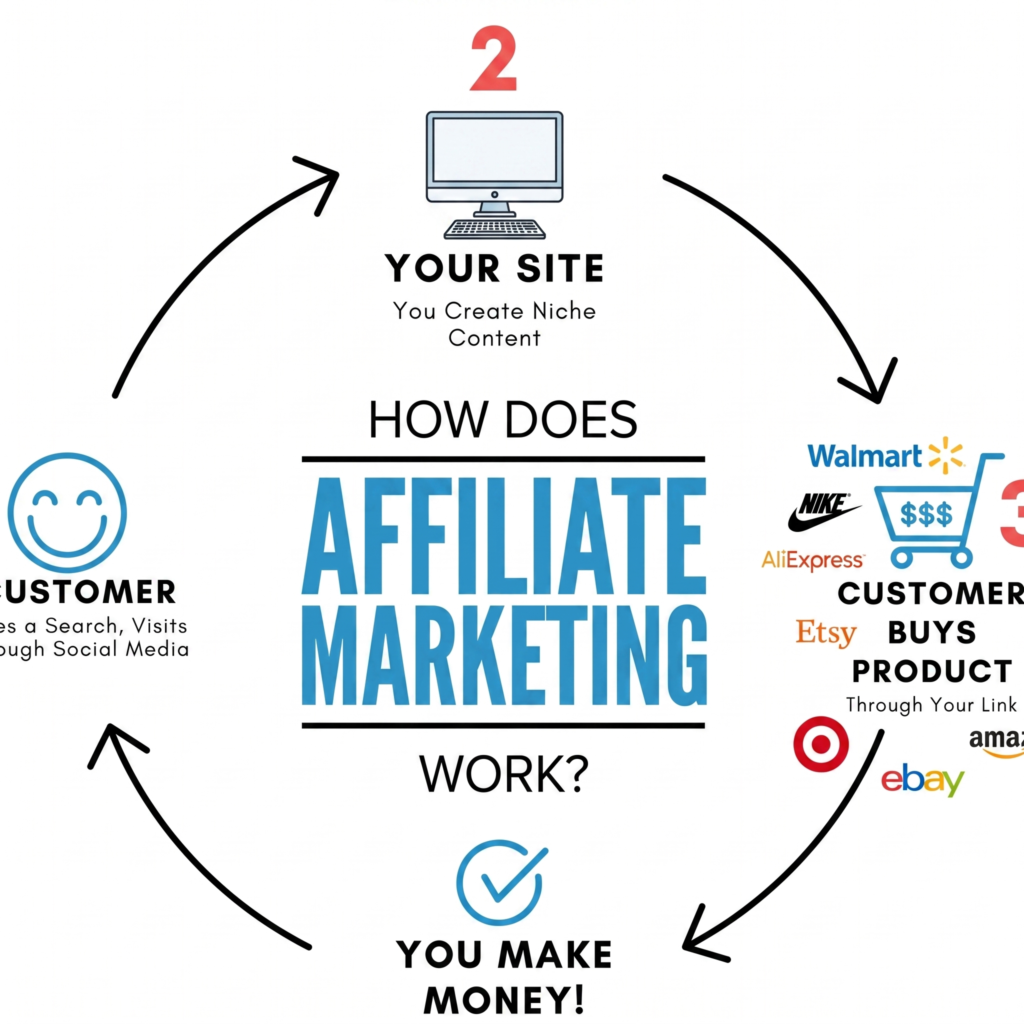
The mechanics of affiliate marketing rely on a clean, four-part system. Each player serves a specific role in keeping the transaction seamless:
.
Each plays a specific role in the process. Here’s how the process works from start to finish:
1. The Affiliate (You)
You create helpful content within your chosen niche. When you join an approved affiliate program, the company provides you with a unique tracking URL containing your specific ID.
2. The Merchant
This is the brand or business that creates and sells the product. When a reader clicks your link, a digital “cookie” is placed in their browser, notifying the merchant’s system that you referred them.
3. The Network
While some merchants run their own in-house programs, many use affiliate networks (like ShareASale or ClickBank). These platforms act as a middleman, safely managing the tracking, reporting, and monthly payouts to save time for both you and the merchant.
4. The Customer
A visitor reads your content, clicks your link, and purchases the product directly from the merchant. They pay the standard retail price, the merchant gains a customer, and you receive your hard-earned commission.
In Simple Terms
Affiliate marketing works because:
- You help people find what they’re looking for
- The merchant gets a sale
- The customer gets a solution
- You earn a commission
It’s a win‑win‑win model, and one of the most beginner‑friendly ways to start an online business.
Why Affiliate Marketing Is One of the Best Online Businesses Today.
Affiliate marketing remains one of the most beginner-friendly and scalable business models available. All you truly need to get started is a laptop, an internet connection, and a specific topic you want to build helpful content around. No matter where you are in the world, it offers an ideal path to digital entrepreneurship.
Here is why it stands out from other online business models:
Low Start-up Costs
You don’t need to invest thousands in product inventory, warehousing, or manufacturing. Your primary investment is your time, your focus, and the helpful content you create.
No product creation or fulfilment:
You promote products that already exist. The merchant handles everything after the sale: payment processing, shipping, customer support, and software updates. Your role is simply to connect the user to the solution.
Work From Anywhere
Whether you are working from home, travelling, or setting up in a local café, your business goes with you. This makes it an incredible opportunity for parents working from home, digital nomads, or anyone seeking a career change.
Uncapped earning potential:
There is no income ceiling. As your content catalogue grows, your traffic and earning potential scale with it. You can expand your revenue by publishing more content, targeting new keywords, or branching into related sub-niches.
Compounding passive income:
Affiliate marketing takes consistent upfront work, but once your helpful content ranks in search engines, it can generate traffic and commissions 24/7, even while you sleep.
Accessible learning curve:
You do not need a degree in computer science or advanced technical skills. With structured training, anyone can learn how to choose a niche, build a basic website, and write helpful articles step by step.
Ultimately, affiliate marketing works because it is built on helping people rather than aggressively selling to them. When you focus on providing true value, the income follows naturally.
Building Trust and Authority (Understanding E-E-A-T)
Building trust is essential for earning the confidence of your readers and ranking in modern search engines. Google evaluates content using a framework known as E-E-A-T: Experience, Expertise, Authoritativeness, and Trustworthiness. Both algorithms and everyday readers want the same thing: clear, accurate, and honest information that genuinely solves a problem.
Two Main Parts with Trust and Authority
1. Winning Trust with Your Search Engines
Search engines reward websites that demonstrate real-world topical depth. To build this algorithmic trust, your content must show:
Trustworthiness: Be completely transparent. Avoid sensationalised hype, use clear affiliate disclosures, and only recommend products you truly back.
Experience: Show your hands-on familiarity with your niche. Use practical insights, personal case studies, and real-world examples.
Expertise: Publish accurate, well-researched information that answers the exact questions your audience is typing into search bars.
Authoritativeness: Cover your topic deeply. Instead of writing one article, create a cluster of supporting guides that link back to your main pillar page.
Trustworthiness: Be completely transparent. Avoid sensationalised hype, use clear affiliate disclosures, and only recommend products you truly back.
2. Winning Trust with Your Readers
Human readers are looking for clarity, guidance, and honesty, not a high-pressure sales pitch. They want to know what is genuinely best for them, not what will make you the highest commission.
You build this human trust by:
Prioritising helpful answers: Focus entirely on solving the user’s problem first, and introduce products only when they are a logical fit.
Radical transparency: Clearly explain why you recommend a tool, including both its pros and its cons.
Writing for people, not algorithms: Prioritise conversational clarity, easy-to-read formatting, and immediate usefulness in every paragraph.
The golden rule of affiliate marketing is simple: Help first, recommend second. This core philosophy is what separates highly successful affiliate publishers from those who struggle to make a single sale.
You build reader trust by:
- Prioritising helpful answers: Focus entirely on solving the user’s problem first, and introduce products only when they are a logical fit.
- Radical transparency: Clearly explain why you recommend a tool, including both its pros and its cons.
- Writing for people, not algorithms: Prioritise conversational clarity, easy-to-read formatting, and immediate usefulness in every paragraph.
The golden rule of affiliate marketing is simple: Helping, not selling: You help first, recommend second. This core philosophy is what separates highly successful affiliate publishers from those who struggle to make a single sale.
Finding Your Niche
Choosing your niche is the most critical foundational step in your affiliate journey. Your niche defines your target audience, dictates the topics you will write about, and determines how your website will scale over time.
A clear, specific niche allows you to:
- Attract a highly targeted, motivated audience.
- Create deeply focused, helpful content easily.
- Build topical authority much faster in Google’s eyes.
- Avoid competing head-to-head with massive, multi-million dollar websites.
Why Your Niche Matters
A niche gives your website direction. Without one, your content becomes scattered, your audience becomes confused, and search engines struggle to understand what your site is about.
To choose a niche that works, focus on:
- A Specific Audience: Who are you helping?
- A Specific Problem: What are they trying to solve?
- A Specific Interest or Topic: What will your content focus on?
When your niche is clear, everything else becomes easier: content creation, keyword research, internal linking, and monetisation.
Broad vs. Narrow Niches: Finding the Sweet Spot
Choosing a niche requires a careful balance. If your topic is too broad, you will face impossible competition from established media giants. If your topic is too narrow, you will run out of things to write about and won’t have room to grow.
Avoiding a Niche That’s Too Broad
Avoid Overly Broad Niches
Broad niches cover massive topics with millions of searches, but high-authority sites completely dominate them. New websites will struggle to rank here.
Examples of overly broad niches: Health, Fitness, Gardening, Fishing, Biking.
Avoid Overly Narrow Niches
On the flip side, a niche can be too restrictive. If there is no search demand or very few subtopics, your growth will stall.
- Examples of overly narrow niches: Vegan snacks for toddlers with nut allergies; Fishing lures for one specific lake in Scotland; Yoga mats exclusively for pregnant women in their third trimester.
The Goal: Choose an Expandable Niche
Your target should be a niche that is specific enough to avoid massive competition, but expandable enough to support dozens or hundreds of articles over time.
A perfect “sweet spot” niche solves a specific problem for a specific group of people, but leaves room for multiple subtopics.
| Overly Broad Niche | The Sweet Spot (Start Here) | Potential Cluster Topics for Growth |
| Fitness | Weight loss for women over 50 | Low-impact cardio, meal planning, joint-friendly gear |
| Fishing | Surf and beach fishing for beginners | Saltwater reels, bait selection, reading ocean tides |
| Gardening | Indoor gardening for small apartments | Low-light plants, vertical planters, hydroponic kits |
| Biking | Mountain biking gear for beginners | Entry-level bikes, helmet safety reviews, trail maintenance tools |
Once your niche foundation is set, every other step – your content strategy, keyword research, internal linking, and monetisation plan- becomes vastly easier to execute.
How to Choose Your Niche: A Step-by-Step Framework
Choosing a niche doesn’t require expensive software or hours of endless scrolling. In fact, one of the most effective ways to find your niche is to disconnect from the digital noise, grab a pen and paper, and start brainstorming.
Writing by hand slows your thinking just enough to force mental clarity. It helps you see hidden patterns, spot market opportunities, and avoid the trap of overthinking.
1. The Brainstorming Process
On a blank sheet of paper, list any topic you are interested in, curious about, or willing to learn. You do not need to be an advanced expert. In modern affiliate marketing, documenting your journey as a passionate explorer is often more relatable and profitable than acting like a rigid academic.
Use these five prompts to uncover your hidden niche ideas:
- Your Interests: What topics do you naturally enjoy reading, watching videos, or learning about in your spare time?
- Your Daily Skills: What are you good at, even if it’s just at a basic, everyday level? (e.g., meal prepping, budgeting, basic home repairs).
- Your Unique Experiences: What major challenges have you successfully overcome that others are currently facing? (e.g., losing 20 pounds, setting up a remote workspace, training a stubborn puppy).
- Your Active Hobbies: What do you do for fun that requires specific gear, tools, or knowledge?
- Your Curiosities: What is a new topic you would genuinely enjoy researching deeply over the next 12 months?
Pro Tip: Do not censor yourself during this stage. Write down every single idea that comes to mind.
2. Narrowing Down Your List
Once your brainstorming session is complete, evaluate your favourite ideas against these four critical parameters to find your winner:
- Is there search demand? Are everyday people actively searching for answers, products, or reviews in this space?
- Is it specific enough? Can you clearly define the exact group of people you are trying to help?
- Is it expandable? Will you have enough unique content ideas to write at least 50 to 100 articles over time?
- Can you provide real help? Do you feel confident that you can create content that genuinely guides someone toward a solution?
Avoiding the “Shiny Object” Trap: Staying Focused
During the niche selection phase, distractions are your biggest enemy. It is incredibly common for beginners to jump from idea to idea, chase passing trends, or get completely paralysed by the sheer volume of options available.
Chasing distractions fragments your focus, breeds self-doubt, and delays your progress. To launch a successful site, you must learn to block out the noise.
Common Niche Distractions to Avoid
- Chasing Viral Trends: High-hype niches (like a specific viral gadget or a passing crypto fad) rise incredibly fast but crash just as quickly. They lack the long-term stability needed to build an evergreen affiliate business.
- The “Perfection” Fallacy: There is no such thing as a perfect niche. Successful affiliate marketing relies entirely on execution, consistent content creation, and helpfulness—not finding a magical, competition-free topic.
- Managing Multiple Sites: Attempting to build two or three websites simultaneously splits your attention, dilutes your energy, and ensures that none of them get the momentum required to rank. Focus on one site until it is profitable.
- The Comparison Trap: Analysing massive multi-million dollar authority sites can make you feel like a market is completely saturated. Remember: you don’t need to beat the giants; you need to serve a specific pocket of their audience better than they do.
How to Maintain Total Focus
Set a strict time limit for your market research (e.g., 48 hours). Evaluate your ideas using the same criteria, pick the winner that aligns best with your lifestyle, and commit to it completely. You can always pivot or refine your angle later, but you cannot build momentum without initial commitment.
When you’re choosing your niche, distractions can easily pull you off track. It’s common for beginners to jump from idea to idea, chase trends, or get overwhelmed by too many options. Mainly because distractions make it harder to focus and can delay your progress.
Staying focused during this stage helps you choose a niche with confidence and move forward without second‑guessing yourself.
Proven Niche Categories That Consistently Perform
If you are struggling to narrow down your brainstorming list, look closely at these proven, high-performing categories. These spaces have massive commercial demand, high affiliate commission potential, and endless subtopics for beginners to tap into.
1. Evergreen Niches (Highest Long-Term Value)
These topics remain deeply relevant to human biology and society year after year, guaranteeing steady, predictable traffic patterns.
- Health and Wellness: Focus on specific sub-niches like joint-friendly fitness, mindfulness for busy executives, sleep optimisation, or targeted nutritional strategies.
- Personal Finance: High-intent topics including family budgeting frameworks, micro-investing for beginners, intentional saving strategies, or credit rebuilding tools.
- Home and Lifestyle: Practical spaces like vertical apartment gardening, Marie Kondo-style minimalist organisation, eco-friendly DIY home improvements, or smart home automation.
2. Passion and Hobby Niches (Highest Brand Loyalty)
People spend heavily on their personal passions, making these niches incredible magnets for product reviews and recommendations.
- Outdoor Activities: Deeply focused sectors like ultralight backpacking gear, urban bicycle commuting, saltwater surf fishing, or car camping setups.
- Pets and Animal Care: High-growth segments like organic puppy nutrition, positive reinforcement dog training, specialised gear for senior pets, or indoor cat enrichment.
3. Emerging Niches (Lowest Initial Competition)
These are cutting-edge areas experiencing rapid growth and search demand, offering a massive advantage to early creators.
- AI and Digital Automation: Solopreneur tools, workflow automation software for remote creators, or generative AI prompting templates.
- Sustainable Living: Zero-waste household swaps, home solar setups, off-grid power solutions, or ethical fashion choices.
Pro Tip:
If you’re unsure where to start, pick a niche that matches your interests and lifestyle. You’ll find it easier to create content consistently and connect with your audience authentically.
Validating Your Niche and Sub-Niche
Before you spend a single dollar on a domain name or write your first article, you must validate your chosen topic. Validation is your insurance policy. It ensures your niche has healthy search demand, a motivated audience, and clear opportunities to generate affiliate commissions.
Skipping this step risks building a beautiful website around a topic that is either too tiny to generate traffic, or so competitive that ranking is impossible.
The 4-Point Niche Validation Checklist
To confirm your topic can support a profitable, long-term website, ensure it checks these four essential boxes:
- Consistent Search Demand: Use a search engine or free keyword tool to ensure people are typing varied queries about your topic year-round, not just a single seasonal keyword.
- Deep Content Room: Brainstorm whether you can easily list at least 30 to 50 individual article ideas right now. If you run out of ideas after five topics, your niche is a hobby, not an affiliate business.
- Healthy Competition: Finding other blogs, forums, and social media groups in your niche is a great sign—it proves there is money to be made. You want to see competition, but you want to look for gaps they are missing.
- Natural Monetisation Paths: Search platforms like Amazon, ShareASale, or niche-specific brands to confirm that relevant products, digital courses, or software tools offer public affiliate programs.
SIGNS OF A WINNING NICHE: Clear problems to solve + accessible affiliate programs + a specific target audience.
SIGNS YOU NEED TO ADJUST: Tiny search volumes + zero products to promote + a topic based on a dying short-term trend.
Locking In Your Sub-Niche
Once the broad niche is validated, lock down your sub-niche, the specific angle you will conquer first to build rapid authority.
Remember, your sub-niche is simply where you start, not where you are trapped forever. For example, if your main niche is Pets, your starting sub-niche might be Pet care for small dog breeds. Once you dominate that small space and rank your first 20 articles, you can logically expand out into larger dog breeds.
Dominating a narrow sub-niche first allows you to bypass massive authority websites and win Google’s trust rapidly.
Building Your Website: Your Digital Home Base
With your niche locked in, it is time to build your website. This is your digital headquarters, the home base where your helpful content lives, where your audience discovers answers, and where your affiliate recommendations fit naturally.
You do not need to be a programmer or a tech genius. Modern web tools have completely simplified this process, making it fast, affordable, and entirely beginner-friendly.
1. Choosing Your Platform and Hosting
The gold standard for content-driven affiliate websites is WordPress (specifically self-hosted WordPress.org). It powers over 40% of the web because it offers total layout control, unmatched SEO scalability, and complete ownership of your business asset.
When setting up your site, your choice of hosting matters immensely:
- Generic Web Hosts: Often leave you to handle complex security, database setups, technical optimisations, and site speed tweaks completely on your own.
- Premium Managed Hosting Ecosystems: Platforms like Wealthy Affiliate (which we will break down in detail later) strip away the technical stress. They handle your site security, automated backups, daily optimisation, and expert support under one roof, leaving you completely free to focus entirely on writing your content.
2. Selecting a High-Performance Theme
In 2026, website loading speed is a critical search engine ranking factor. Avoid heavy, bloated themes packed with flashy animations that slow down mobile devices.
Instead, opt for a highly optimised, lightweight theme like GeneratePress. It’s universally praised by top SEO professionals because it is lightning-fast, fully responsive on mobile phones, and provides a clean, modern layout that makes your articles easy to read.
3. Installing Essential Plugins
Plugins are like apps for your website, adding advanced features without requiring a single line of code. To keep your site running at peak performance, keep your plugin list minimal and focused on these four pillars:
Installing Plugins
Plugins add functionality without needing coding skills.
- SEO Plugin: Optimises headers, sitemaps, & metadata (e.g., RankMath)
- Caching Plugin: Speeds up page load times for mobile visitors
- Security Plugin: Protects your dashboard from malicious login attempts
- Backup Plugin: This saves a copy of your hard work.
Note: Wealthy Affiliate members are all covered on all these essential plugins.
4. Constructing Your Core Trust Pages
Before you begin publishing affiliate product reviews, you must establish legitimacy with both human readers and search crawlers. You do this by setting up these five non-negotiable core pages:
- Home Page: Your digital front door. It should clearly state who you help, what your sub-niche is, and guide readers directly to your best informational guides.
- About Page: The heart of your E-E-A-T strategy. Use this page to explain your background, your hands-on experience with the topic, and why you started the site to help people.
- Contact Page: A simple form or email link allowing readers, potential clients, and corporate affiliate managers to reach out to you directly.
- Privacy Policy: A mandatory legal page required by global privacy regulations and modern ad networks to protect user data.
- Affiliate Disclosure: A clear, transparent legal notice explaining to your audience that you may earn a small commission if they purchase a product through your links. Honesty builds trust.
By organising your website cleanly from day one, you establish a rock-solid, professional foundation that search engines love to reward.
Creating Genuinely Helpful Content
Once your website architecture is set up, your day-to-day focus shifts entirely to creating helpful content. This is the absolute heart of affiliate marketing. Your content is the single engine that attracts organic traffic, builds deep audience trust, and ultimately generates affiliate commissions.
Helpful content is written for human readers first, not for search engine algorithms or aggressive sales targets. It should always be:
- Clear & Simple: Easy to read, avoiding overly technical jargon.
- Radically Honest: Transparent about product limitations, pros, and cons.
- Highly Practical: Giving actionable steps that the reader can execute immediately.
- Problem-Focused: Built entirely around answering a specific question.
The 6 Core Content Frameworks for Beginners
To build trust and topical authority quickly, focus on publishing these six foundational content archetypes:
- Comprehensive “How-To” Guides: Detailed, step-by-step instructions that take a reader from a specific problem to a clear solution.
- Foundational Beginner Manuals: High-level overview content designed to help newcomers understand the absolute basics of your sub-niche.
- Curated Product Roundups: Highly structured list posts comparing the best tools or products in your space (e.g., “The 5 Best Inversion Tables for Lower Back Pain”).
- Hands-On Product Reviews: Deep-dive, experience-based breakdowns of a single product to help an uncertain reader make an informed buying decision.
- Direct Comparison Posts: Side-by-side product battles analyzing the crucial differences between two popular market choices (e.g., “Brand A vs. Brand B”).
- Targeted Trouble-Shooting Articles: Short, punchy content addressing a hyper-specific hurdle your audience frequently encounters.
YOUR STRATEGIC INSIGHT: Don’t pretend to be an unapproachable expert. Document your own journey, share your actual results, highlight your personal mistakes, and showcase what you are actively learning. Authentic transparency builds an audience faster than generic, robotic summaries (AI) ever could.
Keyword Research Basics: Speaking Your Audience’s Language
Keyword research is simply the process of discovering the exact phrases, questions, and terms your target audience is typing into search boxes. By understanding their language, you can construct content that directly satisfies their search intent.
You do not need to purchase expensive enterprise software packages to start. You just need to focus on finding low-competition phrases with clear intent.
Focus on Long-Tail and High-Intent Keywords
As a new affiliate marketer, ignore short, highly competitive terms like “fishing” or “fitness”. Instead, focus heavily on Long-Tail Keywords
Longer, highly specific phrases that carry lower search competition but indicate a user is looking for a very precise solution.
- Question-Based Phrases: Queries starting with how, what, why, or when (e.g., “How to grow organic basil indoors without a grow light”).
- Buyer-Intent Phrases: Searches used by consumers who are actively on the verge of pulling out their credit cards (e.g., “Best lightweight mountain bike helmets under $150”).
How to Uncover Golden Keywords for Free
Before investing in premium platforms, extract thousands of content ideas using these natural search methods:
- Google Autocomplete: Begin typing your core topic into Google’s search bar and analyse the drop-down predictions that automatically populate.
- People Also Ask (PAA) Boxes: Examine the accordion-style question boxes embedded inside Google’s search results page. These are real, high-volume questions verified by Google.
- Related Search Terms: Scroll to the absolute bottom of your search results page to discover the semantic variations Google recommends.
- The Jaaxy Keyword Tool: For marketers looking to drastically scale their content pipeline, the Jaaxy Keyword Research Tool is an incredible asset. With a single seed phrase, Jaaxy can generate over 100 unique, low-competition keyword variations alongside precise search volume and competition metrics. (Note: You can explore my full Jaaxy tool review and walkthrough here).
Content Planning & The Power of Topic Clusters
To maximise your search rankings, you cannot publish random, disconnected blog posts. You need a simple, intentional content strategy built around Topic Clusters.
A topic cluster organises your website into logical content silos. You create one comprehensive main guide (your Pillar Page) and surround it with multiple specific sub-guides (your Cluster Pages) that all link back to one another.
See a sample below with the main pillar post of Beach Fishing for Beginners
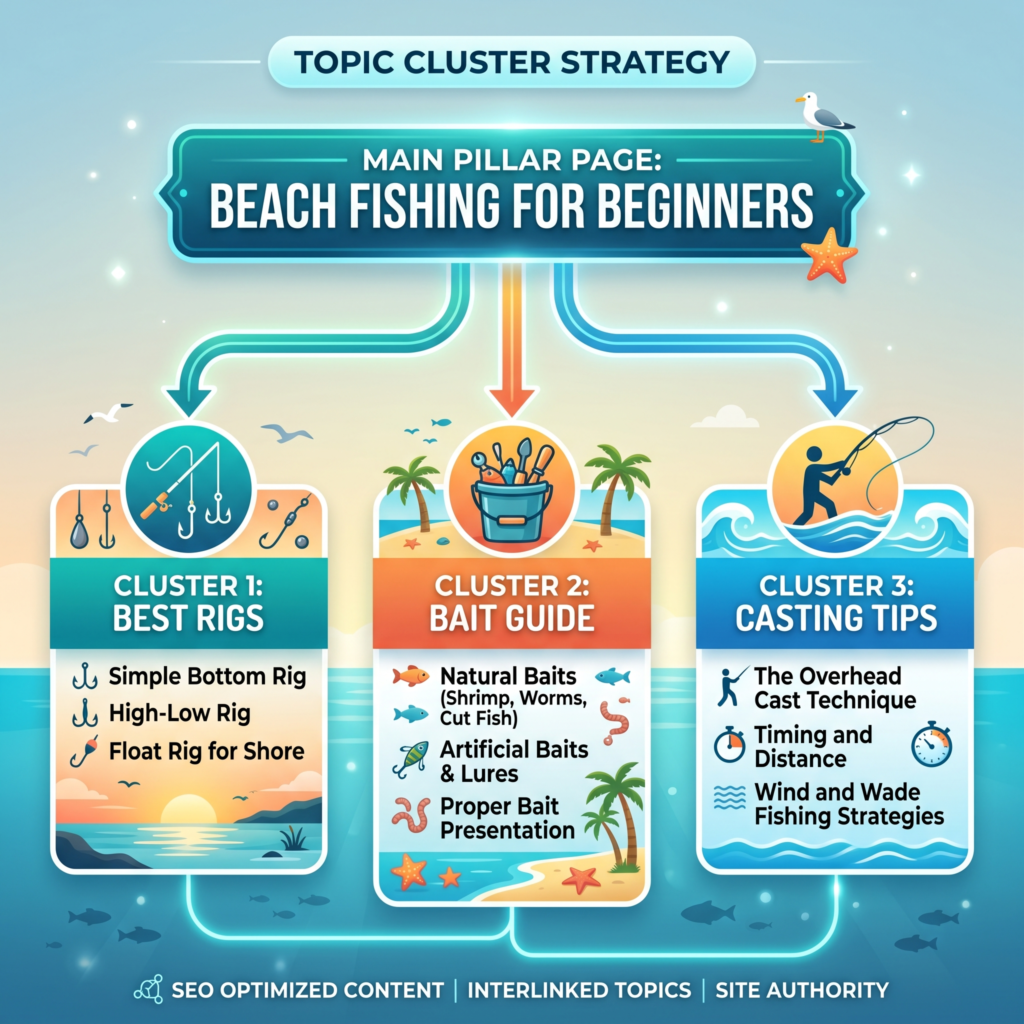
This internal linking structure makes it incredibly simple for human readers to navigate your site, while signalling immense topical authority to search engine crawlers.
Structuring Your Publication Timeline
When rolling out your content calendar, plan your articles in a logical, step-by-step learning sequence for your audience:
- Phase 1: Foundational Information: Build your brand trust first. Publish beginner guides and how-to articles that answer questions without pushing products.
- Phase 2: Technical Skill-Building: Write detailed walk-throughs solving more intermediate hurdles in your sub-niche.
- Phase 3: Product Analysis: Introduce commercial content such as product roundups, honest comparisons, and individual product reviews.
The Golden Rule of 2026 Affiliate Reviews
When crafting commercial product reviews, maintain total integrity. Never produce biased, one-sided content that glosses over flaws just to score a quick commission payout.
Modern readers are highly analytical; they spot hyper-promotional fluff instantly. Clearly present both the pros and the cons, give transparent warnings about who the product is not for, and provide balanced alternative recommendations.
Prioritise Consistency Over Volume
These days with publishing, content consistency matters so much more than raw volume. Publishing one incredibly helpful, deeply researched article per week is infinitely better than rushing out five low-quality, AI-padded summaries that offer no unique real-world insights.
Establish a sustainable writing schedule (such as every Tuesday morning), track your emerging keyword ideas in a centralised spreadsheet, and watch your site’s organic momentum compound steadily over time.
The Foundations of Internal Linking
Internal linking is one of the simplest, yet most powerful search engine optimisation (SEO) actions you can take. An internal link is simply a hyperlink that connects one page on your website to another page on the same site.
These links act as digital pathways, helping search engine crawlers discover your new articles while mapping out your site’s hierarchy. Simultaneously, they keep human readers engaged by seamlessly guiding them to related topics.
The 4 Core Types of Internal Links
To build a highly authoritative website structure, use a natural mix of these four linking models:
- Contextual Links: Hyperlinks placed naturally within the body paragraphs of your text. These carry the highest weight for search engine rankings.
- Cluster Links: Direct links that tie your main pillar guide to your highly specific cluster articles (and vice versa).
- Navigation Links: Structured links embedded within your header and drop-down menus to help users find your most critical content silos.
- Utility Footer Links: Clean links at the base of your site reserved for essential trust pages like your About, Contact, and Privacy Policy forms.
Best Practices for Seamless Internal Linking
- Prioritise Descriptive Anchor Text: Never use lazy, generic anchor text like “click here” or “read more”. Instead, use descriptive, keyword-rich phrases that explain exactly what the target page is about (e.g., “Our full step-by-step beach fishing rigs guide”).
- Maintain Radical Relevance: Only link to content that genuinely serves the reader’s current train of thought. Pumping irrelevant links into an article just for the sake of SEO looks spammy and confuses your visitors.
- The “Two-Way Street” Rule: Whenever you publish a brand-new cluster article, immediately find 2 to 3 older, established posts on your site and link them to the new piece. This passes immediate algorithmic authority down to your fresh content. It’s also known as Passing Google Juice.
Publishing Your First Articles: Building Momentum
Once your technical site layout is secure and your keyword strategy is set, it is time to move from planning to action. Your initial collection of articles sets the baseline for your brand’s authority.
Major Pro Tip.
THE BEGINNER’S TRAP: I have been guilty of this when I first started:
Don’t fall victim to “perfection paralysis.” Your initial goal is raw momentum, not an absolute masterpiece. It is infinitely better to publish a cleanly formatted, highly helpful 1,500-word article today than to spend six months overthinking a single draft. You can always audit, expand, and polish your live content later.
Formatting Your Drafts for Maximum Readability
These days people (your readers) consume information rapidly, primarily on mobile phones. To ensure your content is accessible and easy to digest, follow these formatting guidelines:
- Keep Paragraphs Punchy: Restrict your paragraphs to 2 or 3 sentences maximum. Huge blocks of text intimidate mobile readers.
- Deploy Descriptive Subheadings: Use structured formatting tags (like H2 and H3 headers) so skimmers can effortlessly scan your page and locate the exact answer they need.
- Utilise Visual Bullet Points: Break up long list sequences into clear, digestible fragments.
- Insert High-Value Media: Only include images, infographics, or diagrams if they actively clarify a complex step in your text. Skip generic, low-quality stock photos that add no practical value.
Traffic & Growth Basics: The Power of Search SEO
The most reliable, sustainable, and beginner-friendly method to scale an affiliate marketing business is to focus heavily on Organic Search Traffic (SEO).
Unlike paid advertising, which stops generating visitors the second you turn off your budget, high-quality search content acts as a compounding digital asset. Once your article ranks on page one for a low-competition, long-tail keyword, it will safely attract targeted buyers 24 hours a day, 7 days a week, completely for free.
The Organic Growth Framework
- The Compounding Timeline: Understand that organic traffic starts slowly. For the first few months, your website is sitting inside a natural testing phase while search engines evaluate your consistency. Do not get discouraged. Around the 6-to-12-month mark, your combined topical authority will click, causing your traffic to compound rapidly.
- The Secret of Content Refreshes: Modern search engines heavily reward fresh, updated data. One of the fastest ways to jump your rankings is to regularly review your existing articles, inject updated tips, fix broken links, and polish the layout.
Leveraging Social Platforms Strategically
You do not need to manage profiles on ten different social networks to build an audience. Pick one auxiliary platform that fits your niche perfectly, and use it strictly to amplify your core website content:
Tracking Your Progress: Metrics That Matter
As your business scales, tracking data keeps you focused and prevents guesswork. However, many beginners drown in complicated, unnecessary analytics charts. To keep your scaling strategy sharp, protect your mindset, and focus exclusively on these five essential growth metrics:
- Consistent Publishing Output: The number of highly helpful articles you successfully take live month over month. Consistency is your top priority.
- Organic Impression Growth: Tracking whether your articles are beginning to appear and move upward in organic search result pages.
- Targeted Traffic Inflow: Analyzing whether the number of individual, unique human readers visiting your site is scaling over time.
- Affiliate Link Clicks: Evaluating how many readers are actively engaging with your recommendations and clicking your tracking links.
- Conversion Rate (Sales): The ultimate bottom-line metric tracking how many of your referred clicks result in a verified purchase and a paid commission.
Embracing Simple, Free Analytics Tools
You do not need to invest in overly complex database software or expensive trackers to monitor your site’s growth. Free platforms provide all the foundational metrics a beginner needs without causing technical overwhelm:
- Google Search Console: Your most critical tool. It tracks your exact organic search positions, keyword impressions, clicks, indexing health, and mobile performance directly from Google.
- Bing Webmaster Tools: Shows how your website is indexed and viewed across Microsoft’s search engine ecosystem.
- Google Analytics (GA4): Delivers clean data regarding human user behaviour, tracking how long visitors stay on your pages and how your traffic trends scale monthly.
- Affiliate Program Dashboards: Simple portal metrics tracking your raw tracking link clicks, verified conversions, and finalised commission payouts.
PRO TIP: When you are first launching your site, do not check your traffic dashboards every day. Search numbers naturally fluctuate daily. Checking constantly breeds discouragement during the early stages when your website is still building its foundation. I have been there and done that when I first started! Instead, review your analytics strictly once a month. This lets you observe clear, upward macro-trends rather than daily statistical noise.
6. Keeping Your Content Competitive
Small, structural improvements over time can result in massive ranking gains. Make it a standard operational rule to review your published content catalogue regularly:
- Refresh Aging Guides: Inject updated strategies, clarify confusing sections, and replace outdated references.
- Weave In New Internal Links: Connect older, high-performing articles directly to your newly launched cluster posts.
- Optimise Readability: Polish your layouts based on actual mobile reading patterns to maximise reader engagement.
7. Celebrating the Small Milestones
An affiliate marketing business compounds exponentially. Big financial results are always preceded by small, foundational wins. Make sure to recognise and celebrate these critical milestones on your path:
- Your very first keyword showing up on page 3 or 4 of Google.
- Your first day reaching 10 completely organic, unique human visitors.
- Your first reader actively clicking an embedded affiliate recommendation link.
- Your very first commission sale, regardless of whether it is for 50 cents or fifty dollars. A sale is definitive proof that your system works.
Scaling Your Website into a Digital Asset
Once your foundational topic clusters are established and your organic traffic is rising steadily, you enter the scaling phase. Scaling does not mean working yourself to the point of exhaustion; it means expanding what already works using smarter, systematic systems.
To transition your growing website into a highly stable online business asset, focus on these four scaling levers:
- Double Down on Traffic Winners: Review your analytics to identify your top five highest-trafficked posts. Immediately expand on these successes by building deep, supplementary cluster articles around those specific topics.
- Increase Publishing Frequency Gradually: Do not push yourself to publish daily blog posts. If you are comfortably writing one article per week, optimise your workflow by batch-writing outlines, using standardised templates, and moving to two high-quality articles per week.
- Build Deep Topic Clusters: Systematically transition your site from a narrow sub-niche outward. If you have thoroughly covered beach fishing for beginners, begin branching seamlessly into adjacent topical buckets like deep sea reels or kayak fishing gear.
- Diversify Your Revenue Engines: Protect your business from relying on a single source of income. As your traffic numbers mature, explore joining diverse affiliate programs, launching targeted digital products (such as helpful templates or specialized e-books), and integrating premium display advertising networks.
Actionable Tips for the Beginner’s Journey
It is entirely normal to feel a sense of overwhelm when launching a digital business. Every elite, high-earning affiliate marketer began exactly where you are standing right now, looking at a blank screen, managing a handful of ideas, and wondering if the effort would pay off.
Keep these final guiding rules close to your chest to maintain total momentum through the natural highs and lows of your business growth:
- Progress Beats Perfection: Do not trap yourself in endless editing loops. Write clean, helpful content, hit publish, and let search engines index it. You can always improve an article later.
- Run Your Own Race: Avoid comparing your brand-new website to multi-million dollar media properties that have been active for a decade. Your unique voice and targeted focus are your competitive advantages.
- Learn by Executing: You cannot master keyword intent or digital copywriting by just reading books. You build the skill organically with every single article you construct and take live.
- Expect a Slow Start: Affiliate marketing relies on compounding interest. The initial three to six months will feel quiet while your site wins algorithmic trust. Stay patient, focus on helping your readers, and trust the process.
Conclusion: Your Clear Roadmap to Action
Affiliate marketing remains one of the most accessible, elegant, and rewarding online business models in existence. It requires no predatory sales tactics, massive upfront venture capital, or advanced programming backgrounds. It simply requires a clear niche focus, a clean website structure, genuinely helpful content, and the professional discipline to remain consistent.
You are no longer guessing at what steps to take. You now possess a comprehensive, step-by-step roadmap outlining exactly how to build a real online asset:
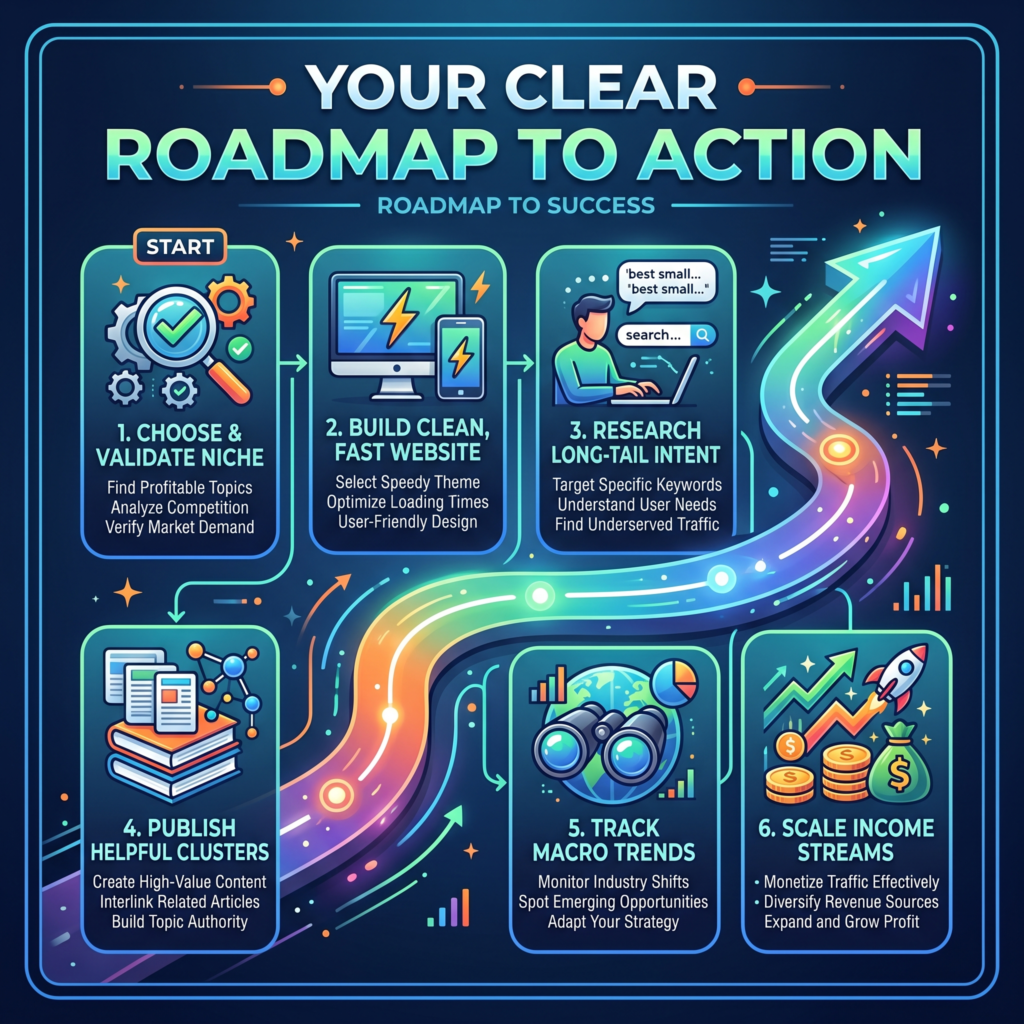
The defining difference between those who build highly profitable affiliate businesses and those who fail comes down to a single element: Action. The vast majority of beginners remain trapped in a state of eternal planning, endless research, and constant hesitation.
You are already ahead of the curve because you understand the correct, trust-first framework required for modern SEO. Break through the noise, build momentum step by step, and play the long game.
8. Remembering the Long-Term Rule
Affiliate marketing rewards four specific traits: patience, consistency, honesty, and persistence.
Your first month will likely be completely quiet. Your second month will feel slow. Your third month will finally begin to show genuine signs of life. And then, the compounding effect takes over.
Traffic grows, search rankings rise, link clicks increase, and your first sales appear. This steady, predictable build is exactly how real, sustainable online businesses are constructed. Every helpful article you publish is a permanent digital asset, and every month you stay consistent moves you closer to long-term freedom.
Ready to Build Your Affiliate Business the Right Way?
You now possess the complete, verified roadmap to digital success. At this point, you face the exact boundary that separates people who simply read about affiliate marketing from the action-takers who actually build a life-changing online asset.
If you want structured guidance, a proven blueprint, and an all-in-one ecosystem that completely removes the technical guesswork, Wealthy Affiliate is the absolute best place to launch your business. It is the exact platform thousands of beginners use to transition from complete confusion to launching a thriving, revenue-generating website.
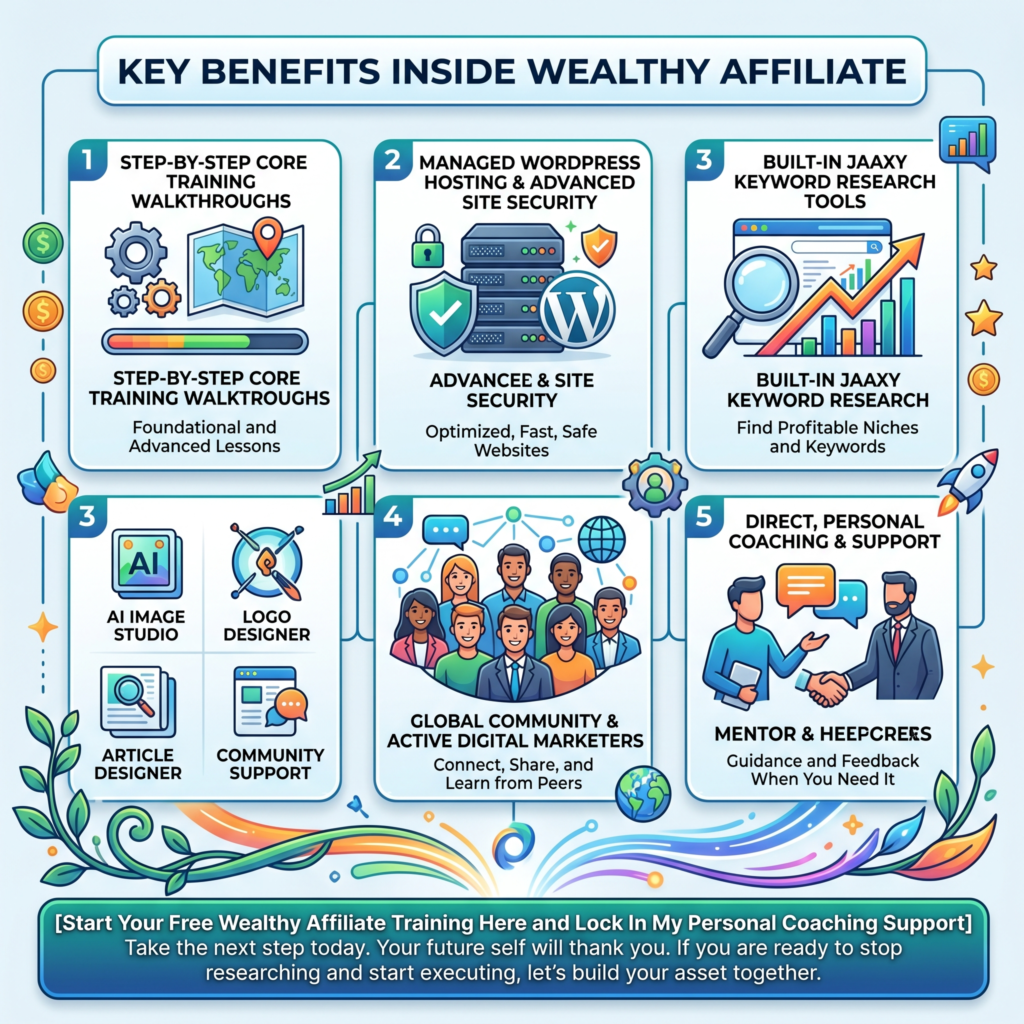
If you’re serious about building an online business, not just reading about it, this is where you start.
Start your free Wealthy Affiliate training here
Take the next step. Your future self will thank you

.
Frequently Asked Questions (FAQ)
What is affiliate marketing in simple terms?
Affiliate marketing is a business model where you earn a commission by recommending products or services. When someone buys through your link, you get paid. It’s one of the easiest ways to start an online business because you don’t need your own product.
How long does it take to make money with affiliate marketing?
Most beginners start seeing small results within 3–6 months, depending on consistency, niche choice, and content quality. Affiliate marketing is a long‑term model; income grows slowly at first, then compounds.
Do I need technical skills to start affiliate marketing?
No. You don’t need coding, design, or advanced tech skills. Modern platforms make everything beginner‑friendly. What matters most is publishing helpful content.
How many articles do I need before I can earn commissions?
Some people earn with as few as 10–20 articles, but most see consistent results after 30–50 helpful posts. What matters is quality, not quantity.
What is the best way to learn affiliate marketing properly?
The fastest way is structured training that teaches niche selection, content creation, SEO, and monetisation step‑by‑step. This is why many beginners (and intermediates) use Wealthy Affiliate’s Phase 1 Core Training, which is beginner‑friendly and always up to date. Learn more in Recommended Training.
Do I need to use social media to get traffic?
No. Most affiliate sites grow through search traffic, not social media. Platforms like Pinterest or YouTube can help, but they’re optional.
What niche should I choose if I’m not an expert in anything?
Choose a niche you’re interested in or willing to learn about. You don’t need to be an expert, you become one by creating content.
How do I know if my niche is profitable?
Any niche is profitable if people search for solutions and products within it. Look for problems, questions, and products people already buy.
Do I need to buy expensive tools to succeed?
No. You can start with free tools like Google Search Console, Bing Webmaster Tools, and basic keyword research methods. Paid tools are optional and only useful later
Can I do affiliate marketing part‑time?
Yes , most people start part‑time. Publishing one helpful article per week is enough to build long‑term momentum
.


I will see you on the other side of success.

 Copyright Learn Earn Grow Online Affiliate Marketing – 2014 – . All rights reserved.